Speaker-Aware Meeting Transcripts That Drive Action
By Assistly ·
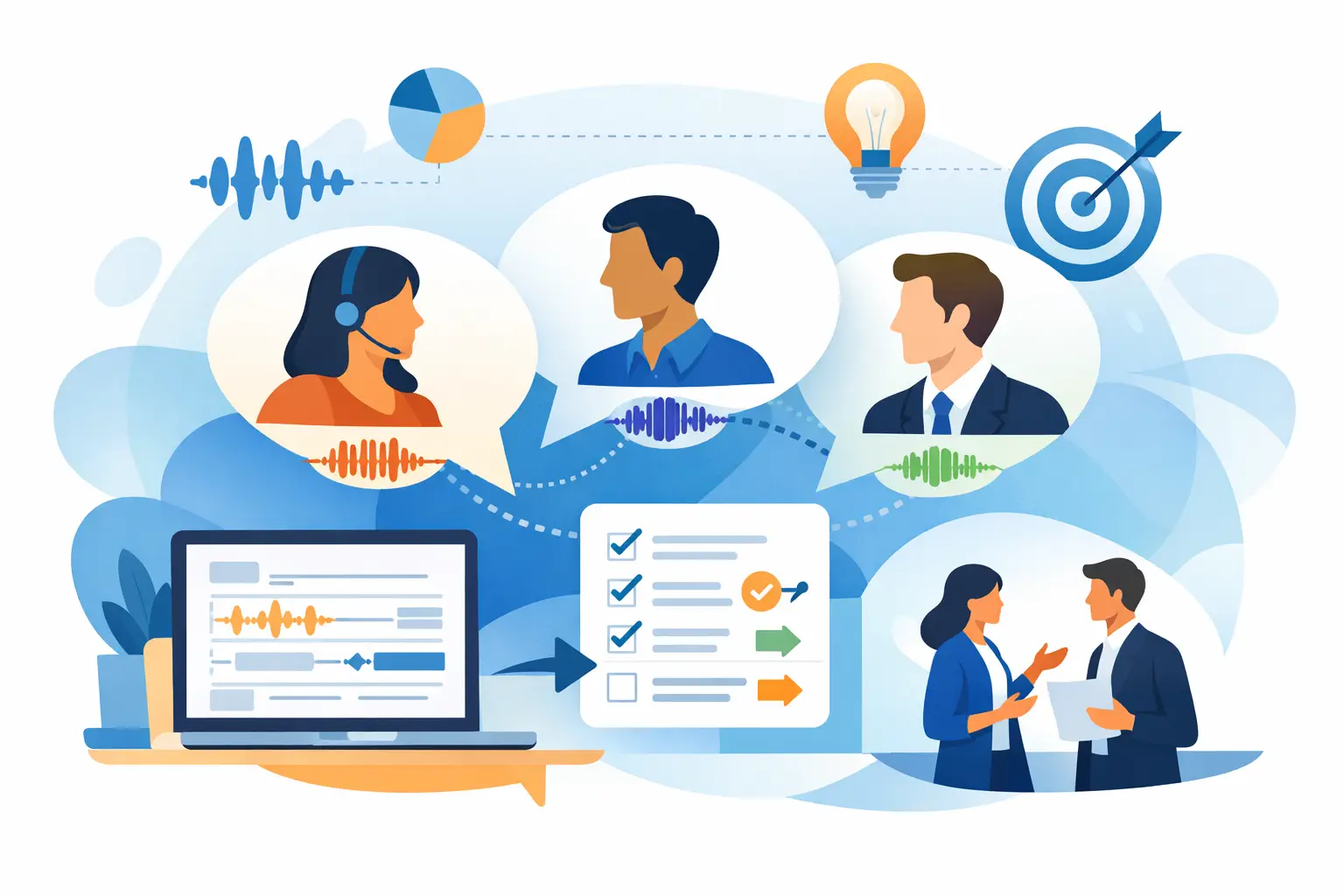
A sales call goes quiet after a pricing question. An interviewer asks why you chose a specific technical approach. A project lead commits to a deadline, then changes the scope two minutes later. These are the moments speaker-aware meeting transcripts earn their place. They do not just capture words. They preserve who said them, when they said them, and what the statement meant in the conversation.
That difference changes how professionals prepare, respond, and follow through. A transcript that reads like an anonymous wall of text creates more work. A transcript mapped to the people in the room gives you usable intelligence while the details are still fresh.
What speaker-aware meeting transcripts actually capture
Traditional transcription answers one question: what was said? Speaker-aware transcription answers a more useful one: who said what?
The system separates participants into distinct speaker labels as audio arrives. Instead of reading, "We need legal approval before launch," with no attribution, you can see whether it came from the buyer, the legal stakeholder, the engineering lead, or your own team. That attribution gives the sentence weight. A concern voiced by an executive is different from a passing comment from a meeting attendee. A deadline stated by a decision-maker carries different consequences than a date suggested by a contributor.
This is not perfect identity recognition in every setting. Speaker labels can be affected by overlapping voices, weak microphones, noisy rooms, or participants who join from the same conference device. The goal is reliable conversational separation, not magic. In most professional calls, clear attribution is enough to make the transcript dramatically more useful.
For high-stakes work, the practical value is immediate. You can track the person asking the hard questions, the stakeholder who owns the next decision, and the colleague who volunteered to deliver a follow-up. The meeting stops being a blur of voices and becomes a structured record of commitments.
Why attribution changes the quality of your notes
Most professionals do not need more notes. They need notes they can trust under pressure.
Without speaker context, post-call review becomes an investigation. You replay clips to determine who objected to the proposal. You scan messages to remember which manager promised an introduction. You hesitate before assigning a task because the transcript does not clearly show ownership.
Speaker-aware transcripts reduce that uncertainty. They preserve the chain between statement, speaker, and outcome. That makes the record useful for decisions, not just documentation.
For sales conversations
A sales rep needs to know whether a budget objection came from the economic buyer or a user who is gathering information. Those are different signals. The first may require a pricing strategy. The second may require better value framing.
Speaker-level transcripts also help account teams identify buying roles after the call. Who asked about implementation? Who asked about security? Who pushed for a timeline? Each question reveals a concern, and each concern should shape the next message.
For interviews and technical assessments
Candidates often leave an interview remembering the broad themes but losing the exact language of the questions. That is costly when the next round depends on a follow-up, a technical clarification, or a thank-you note that proves you were listening.
When the transcript shows which interviewer raised a system design constraint or challenged an assumption, you can prepare with precision. You are not guessing at what the panel cared about. You have a record of the discussion and the context behind it.
For managers, consultants, and operators
Meetings fail after the call when ownership is vague. "Someone will send the revised plan" is not an action item. "Jordan will send the revised plan by Thursday" is.
Attribution makes it easier to turn spoken commitments into accountable work. It also protects teams from revisionist memory. If priorities change, you can see where the change started, who agreed, and what needs to move with it.
The live advantage: context before the meeting ends
Post-session notes are valuable. Live context is where the pressure comes off.
In a consequential conversation, you rarely have time to manually capture every detail. You are listening, responding, watching reactions, and deciding what to say next. Looking down to type notes can break eye contact. Trying to retain every name, objection, and request drains attention from the conversation itself.
A live speaker-aware transcript gives you a private reference point while the discussion is still moving. If someone raises an objection, you can see the exact wording rather than relying on a rushed mental summary. If a stakeholder mentions an earlier requirement, you can trace the thread before you answer.
That does not mean reading from a transcript or treating it as a script. The strongest use is selective. Glance when names, numbers, commitments, or objections matter. Stay present for everything else. The transcript supports your judgment. It should not replace it.
Assistly is built for that kind of control. It captures microphone and call audio, separates live conversation by speaker, and provides private on-screen context without adding a visible participant to the meeting. You stay focused on the people in front of you. The notes keep up in the background.
What to look for in a speaker-aware transcript tool
Not every transcription tool is designed for a live professional conversation. Some are useful archives but offer little help until the meeting is over. Others produce a transcript but fail to turn it into something you can act on.
A capable tool should handle four jobs well:
- Separate speakers clearly enough to preserve ownership and conversational flow.
- Display live text quickly enough to be useful during the call, not just afterward.
- Create searchable summaries that retain decisions, action items, and key questions.
- Protect your working view so you can use it without cluttering the meeting or distracting from the conversation.
The right balance depends on your role. A recruiter may care most about interview questions and candidate responses. An account executive may prioritize objections, buying signals, and next steps. An engineering manager may need a clean record of technical decisions and dependencies.
Accuracy matters, but context matters just as much. A near-perfect transcript with weak speaker labels can still create confusion. A concise summary with no evidence trail can omit an important qualifier. Look for a workflow that lets you move between live details, speaker context, and post-session follow-through.
Turn transcript data into a sharper follow-up
The transcript is only valuable if it changes what happens next. After a call, use speaker attribution to validate three things: the decision, the owner, and the deadline.
First, identify decisions that were actually made. Teams often confuse discussion with agreement. Look for direct language such as "we will," "approved," "send it," or "let's move forward." Then confirm who said it and whether anyone attached a condition.
Next, identify owners. Assigning a task to the wrong person creates friction fast. Speaker-aware records make it easier to distinguish between the person who requested work, the person who agreed to do it, and the person who needs to approve it.
Finally, capture deadlines and dependencies. A commitment may sound firm until the transcript reveals a qualifier: "after legal review," "if procurement signs off," or "once the data is ready." Those clauses are where projects slip. Preserve them in the follow-up instead of turning a conditional statement into an unconditional promise.
For sales teams, this can become a cleaner recap: the buyer's priorities, each stakeholder's concern, the agreed next step, and the date attached to it. For candidates, it can become a focused preparation plan for the next interview. For managers, it can become a short action list that people can verify rather than debate.
Privacy, consent, and professional judgment
Conversation intelligence is powerful because meetings contain sensitive information. Treat recordings and transcripts accordingly.
Follow your company's recording policies and the applicable consent requirements for the people and locations involved. Be deliberate about where transcripts are stored, who can search them, and how long they remain available. A transcript may contain customer details, compensation discussions, product plans, or internal decisions that should not travel casually through personal accounts or shared folders.
There is also a human trade-off. Over-documenting every conversation can make people less candid. The goal is not to create a surveillance record. It is to capture the information required to make better decisions, honor commitments, and avoid forcing people to repeat themselves.
Use the tool with the same discretion you would bring to a meeting notebook. The difference is that the notebook can now tell you exactly who owned the promise.
Make the conversation easier to win
The best meeting transcript does not make you sound rehearsed. It makes you harder to catch unprepared.
When you can see the flow of the conversation, retain the exact language of a key objection, and leave with clear ownership, you operate with more control. You spend less time reconstructing the call and more time acting on it. That is the real value of speaker awareness: not more text, but a clearer path from conversation to execution.